WFL Fork Sensor SICK – Accurate Detection, High Stability
Overview:
- Highly precise laser beam ensures consistent measurement accuracy across the entire measuring range and reliable detection of extremely small objects
- Visible laser beam enables easy alignment and fast adjustment
- Simple and reliable setting via teach-in button ensures high process reliability
- A wide range of different fork sizes increases mounting flexibility
- Stable aluminum housing for use in harsh industrial environments
- Thanks to IO-Link or teach-in button, the switching threshold can be adjusted while the process is running, increasing process reliability
- Easy access to data from the PLC via IO-Link
WFL SICK Sensor Overview
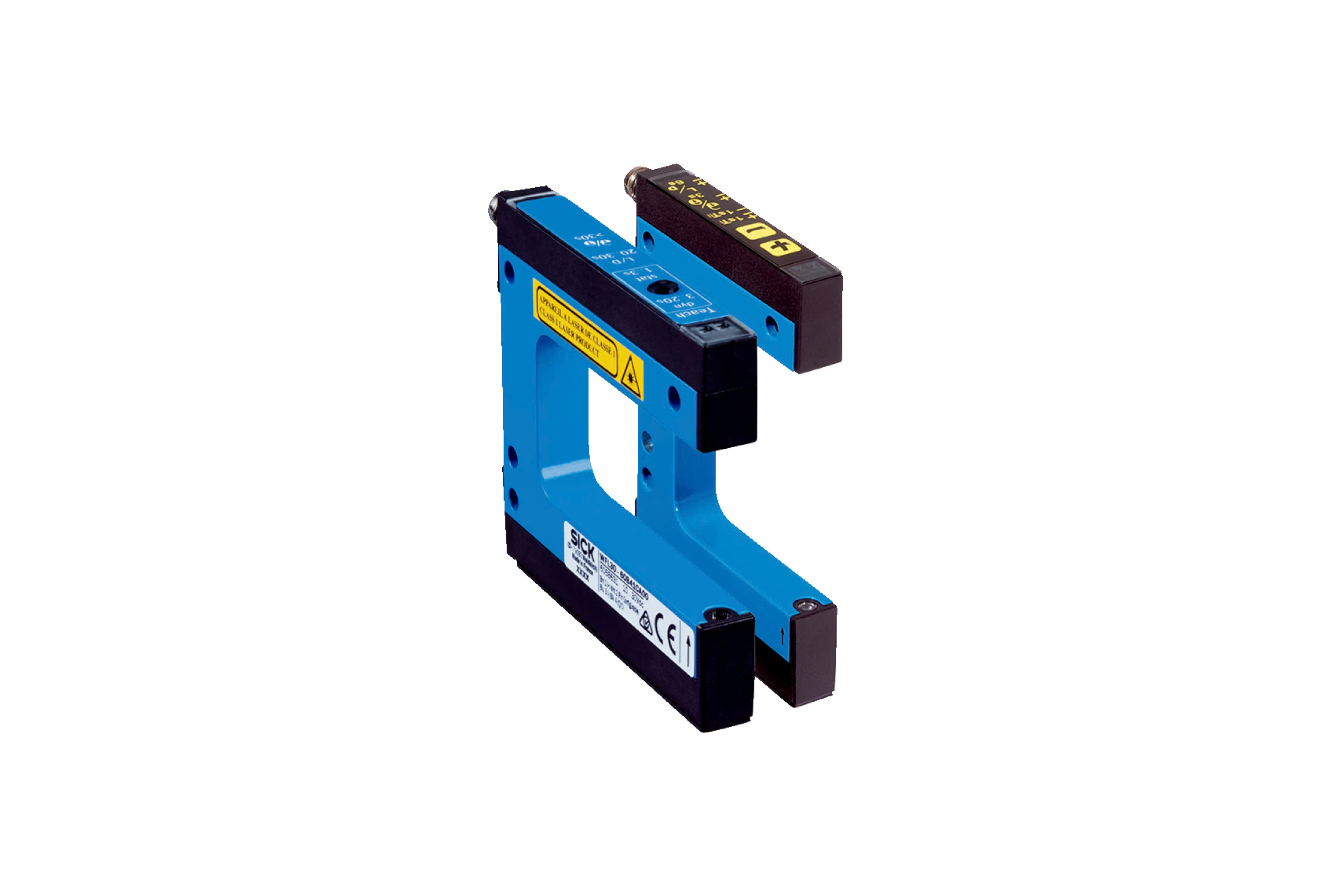
The WFL (Laser Fork Sensor) is a fork-type optical sensor using SICK’s laser technology, specialized for applications requiring high accuracy and fast response times. The emitter and receiver are integrated into a sturdy aluminum housing, forming a U-shape (fork) structure, eliminating the need for distance adjustment. With a visible red laser source, the WFL can detect objects as small as 0.05mm, making it suitable for detecting decals, thin webs, metal wires, transparent materials, and light-sensitive products. The product is widely used in packaging, printing, pharmaceutical, and electronics industries in Vietnam.
Key Specifications:
- Minimum detectable object (MDO): 0.05mm – detects extremely small objects
- Response time: ≤ 100µs, switching frequency 10kHz
- Fork width: 2mm, 5mm, 15mm, 30mm, 50mm, 80mm, 120mm
- Fork depth: 42mm, 59mm, 95mm (3 versions)
- Light source: Visible red laser (Class 1), IP65 enclosure rating
WFL Technical Specifications
Performance & Optics
| Parameter |
Value |
| Sensor type |
Fork-type optical sensor (Fork sensor) |
| Operating principle |
Optical – Through-beam |
| Light source |
Visible red laser |
| Minimum detectable object (MDO) |
0.05mm |
| Fork width |
2 mm … 120 mm |
| Fork depth |
42 mm … 95 mm |
| Response time |
≤ 100µs \ ≤ 60µs |
| Switching frequency |
10kHz / 11 kHz |
| IO-Link |
Yes (depending on variant) |
| Teach-in mode |
2-point teach-in via +/- button |
Electrical & Mechanical
| Parameter |
Value |
| Supply voltage |
10 – 30 VDC |
| Power consumption |
40mA (no load) |
| Startup time |
100ms |
| Output |
PNP/NPN (Light/Dark switching) |
| Maximum output current |
100mA |
| Connection type |
M8 4-pin male connector |
| Housing material |
Aluminum |
| Weight |
36g – 160g (depending on fork width) |
| Dimensions (WxHxD) |
10mm x 88.5mm x 74mm (WFL50) |
| Enclosure rating |
IP65 |
| Operating temperature |
-20°C to +50°C |
| Storage temperature |
-30°C to +80°C |
| Ambient light immunity |
≤ 10,000 lux |
| Laser safety certification |
Class 1 (IEC 60825-1) |
| Certifications |
CE, cULus, UKCA, RoHS |
Information from Product Overview WFL
Industrial Applications of WFL
With the ability to detect extremely small objects and ultra-fast response time, the WFL is suitable for applications requiring high accuracy in Vietnam:
- Label detection in packaging and printing industries: The WFL accurately detects the position of decals and labels on high-speed conveyors. The 0.05mm MDO enables detection of even thin and transparent labels. The 100µs response time ensures no labels are missed even when machines run at high speeds (up to 10,000 labels/second). 2-point teach-in helps set the optimal switching threshold between backing paper and label.
- Thin web inspection in pharmaceuticals: Detects blister packs and medicine bottles on automated packaging lines. The visible red laser beam makes installation alignment easy. IP65 dust protection suits cleanroom environments. PNP/NPN outputs are compatible with Siemens, Mitsubishi, and Omron PLCs.
- Metal wire and transparent material detection: The WFL accurately detects thin metal wires (sewing needles, cables), transparent plastic films, and light-sensitive materials thanks to its highly focused laser beam. No emitter-receiver distance adjustment is needed due to the integrated fork design. The device lock function prevents unwanted threshold changes.
- Product counting on conveyors: With a 10kHz switching frequency, the WFL accurately counts products moving at high speeds. Jitter of only 40µs ensures high stability during continuous counting. A wide range of fork widths (2-120mm) suits various product sizes.
WFL Model Comparison
| Model |
Fork width |
Fork depth |
Application |
| WFL2 |
2mm |
42/59/95mm |
Thin wires, sewing needles |
| WFL5 |
5mm |
42/59/95mm |
Small labels, decals |
| WFL15 |
15mm |
42/59/95mm |
Bottle labels |
| WFL30 |
30mm |
42/59/95mm |
Small boxes, blister packs |
| WFL50 |
50mm |
42/59/95mm |
Medium cartons |
| WFL80 |
80mm |
42/59/95mm |
Large boxes, small pallets |
| WFL120 |
120mm |
42/59/95mm |
Pallets, large containers |
*Note on model selection: The fork width must be larger than the size of the object to be detected. If the conveyor is wide or objects are large, choose WFL30/50/80/120. If installation space is limited or objects are small (decals, thin wires), choose WFL2/5/15. The 59mm fork depth is the most common, suitable for most industrial applications.
Frequently Asked Questions About WFL
1. How much does the WFL sensor cost?
The price of the WFL depends on:
- Fork width (2 – 120mm)
- Fork depth (42 / 59 / 95mm)
In Vietnam, the actual price is affected by import duties, exchange rates, and shipping costs. Contact AUMI via hotline 0917 991 589 or email [email protected] for an accurate price quote by part number for your project.
2. Where to buy genuine WFL sensors?
There are many distributors in Vietnam. AUMI is proud to be an officially authorized distributor of SICK in Vietnam, committed to:
- 100% brand new, factory-sealed products
- Full 12-month warranty
- Direct technical support
3. What industries is the WFL used in?
The WFL is specialized for detecting extremely small, transparent, and thin objects at high speeds:
- Packaging: Detecting decals, labels, shrink film
- Printing: Print position alignment, web break detection
- Pharmaceuticals: Inspecting blister packs, transparent bottles
- Electronics: Detecting thin wires, small components (0.05mm)
- Food: Counting products on conveyors
- Logistics: Inspecting boxes, pallets
4. What are the key technical differences between the WFL (red laser) and WF (infrared)?
| Criterion |
WFL (Red Laser) |
WF (Infrared – IR) |
| Wavelength |
650 nm (visible red) |
880 nm (infrared, invisible) |
| Minimum detectable object size |
0.05 mm (filaments, tiny components) |
0.2 mm |
| Transparent object detection |
Good (glass bottles, PE film, plastic blisters) |
Poor (IR penetrates many materials) |
| Light-sensitive material detection |
Good (photo paper, film) |
May cause overexposure or reduced accuracy. |
| Ease of alignment |
Very easy (visible red beam) |
Difficult (invisible beam) |
| Cost |
Higher (due to laser technology) |
Lower |
Technical conclusion: Choose WFL when you need to detect extremely small objects (<0.2mm), transparent, delicate, or light-sensitive materials, and prefer easy alignment. Choose WF (infrared) for simple applications with opaque objects where cost is the priority.
5. How is WFL different from WF (infrared)?
The WFL uses a visible red laser, detects smaller objects (0.05mm vs 0.2mm for WF), and is suitable for transparent and light-sensitive materials. The WF uses infrared (IR) light, is less expensive, and is suitable for detecting opaque objects. If you need high accuracy and transparent object detection, choose the WFL.
AUMI – Official SICK Distributor in Vietnam. Full official warranty, complete CO/CQ, 24/7 technical support.
📞 Hotline: 0917 991 589 (Hanoi) | 0932 226 100 (Ho Chi Minh City)
📧 Email: [email protected]
🌐 Website: https://aumi.com.vn/
📍 AUMI Office Addresses:
- Hanoi: B44, Villa Lot, Viet Hung Urban Area, Long Bien
- Ho Chi Minh City: 2nd Floor, HS Building, 260/11 Nguyen Thai Binh, Tan Binh District
- Da Nang: 9th Floor, PV Bank Building, No. 2 30-4 Street, Hoa Cuong Ward, Da Nang City, Vietnam
🔗 Official Datasheet
🔗 View all SICK products at AUMI
🔗 Explore other SICK sensor series